| https://romaniacs.us/Dulcimer.html |
|---|
Engineering Dulcimer Dampers |
Each image below is linked to its full size image.
The hammered-dulcimer is a musical instrument with ancient roots. But the long sustain of a hammered-dulcimer limits its suitability for musical settings with multiple instruments. In 1874 József Schunda introduced the first pedal-damped concert cimbalom. It is still manufactured and played in Central and Eastern Europe and is a distinctive component of Romanian music's sound.
Although less than a piano, the size and weight of the cimbalom's iron frame makes it non-portable for a single person. Thus the challenge is to add pedal controlled dampers to a lightweight hammered-dulcimer.
|
|
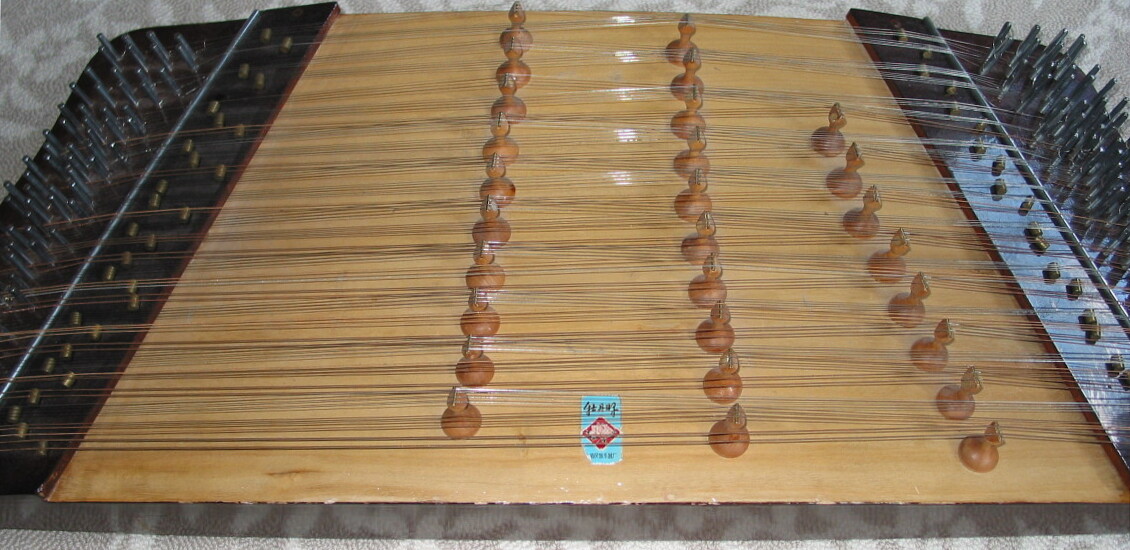
The yangqin is the Chinese hammered-dulcimer. The yangqin in the photo is the small model made before 1983 by the Peony Yangqin Company of Shanghai. The small yangqin is no longer manufactured, replaced by a larger model shown in the Wikipedia Yangqin page.
Some hammered-dulcimer makers offer dampers for their products. The pedal-controlled dampers I found online have the dampers above the rails delimiting the vibrating portion of the strings. This is infeasible for the yangqin because the yangqin has shelves next to the pin-blocks on either side with brass rollers under the strings. However, this configuration raises the strings high enough (>15 mm) over the soundboard to allow the dampers to be placed between the strings and the soundboard.
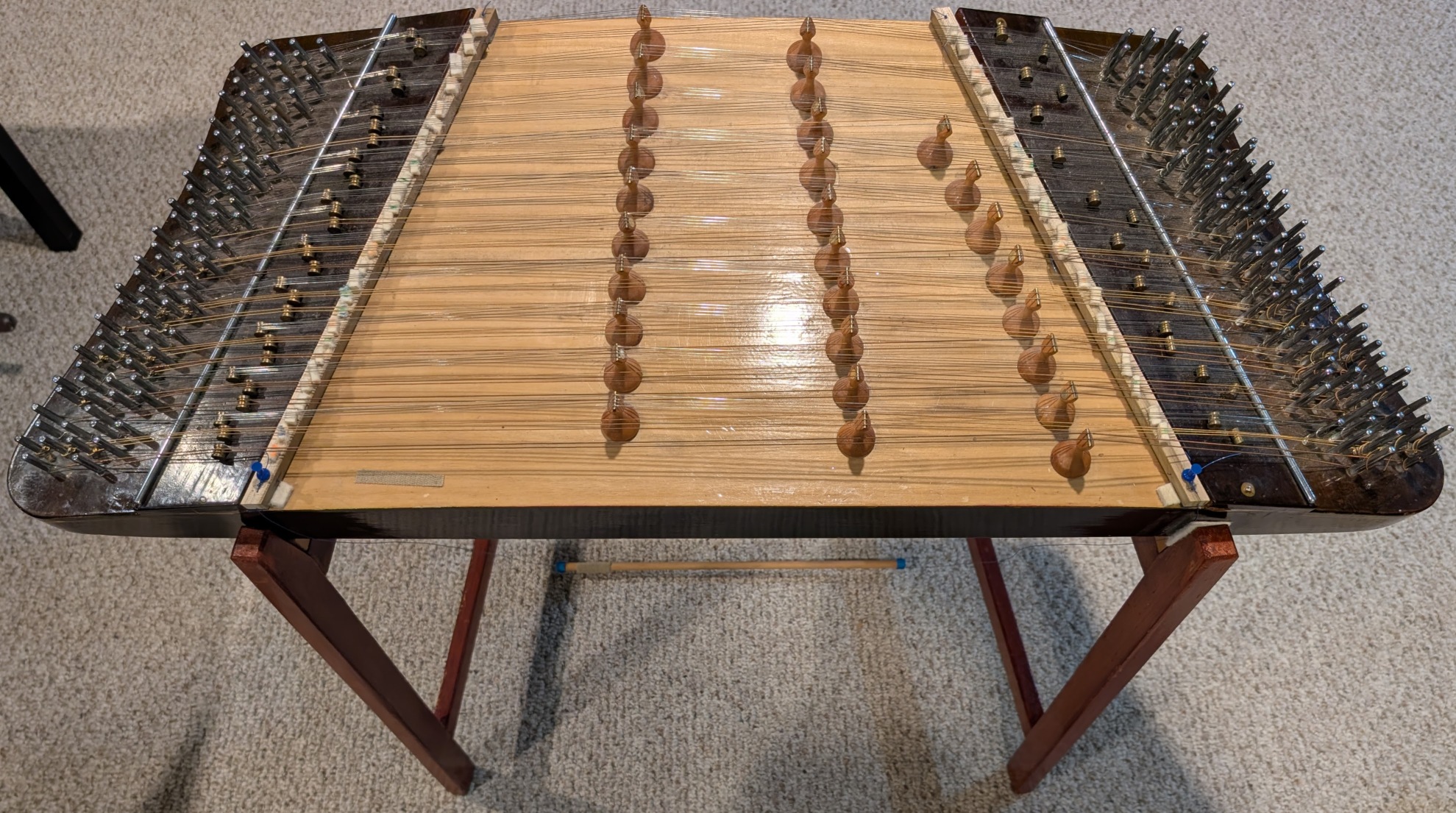
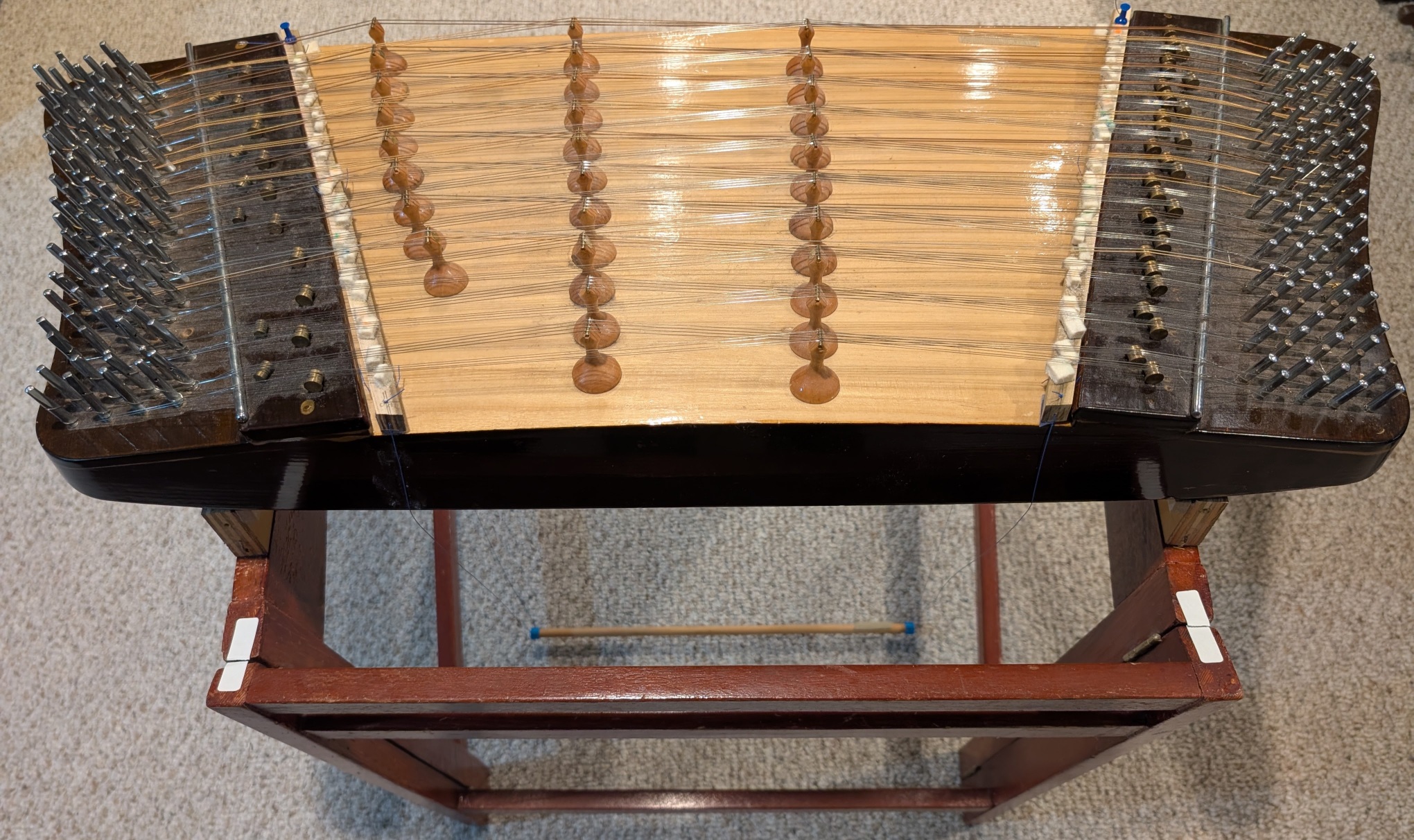
Compared with above-rail dampers, much less force is required to damp the strings. However, damping away from the rail increases chances of raising the string's pitch or of sounding a harmonic; so the force that the dampers exert on the strings must be carefully adjusted. My design has small felt blocks glued to 1.2×1.2×40 cm oak bars. Each bar has three compression springs beneath it exerting a combined 1.25 pounds-force upward (0.417 per spring).
With such small restoring forces acting on the bars, simplicity of connection to the pedal is paramount. An AWG 30 single strand copper wire (with blue sheathing) is strung between the ends of an oak bar, and hangs beneath the yangqin. These two wires wrap around opposite ends of the 9.5 mm-diameter dowel pedal suspended 1 cm above the floor, which can be seen with blue caps in the front and rear views of the modified yangqin.
The strings sustain when the dowel pedal is pressed, and damp otherwise. The vertical travel of the dampers is only 1 mm. There is thin felt between the dampers and soundboard to avoid clicks when the pedal is pressed. A small felt block prevents the near end of the oak bar from wandering when the pedal is pressed. The heights of the felt blocks on top of the oak bars are individually adjusted within about 0.2 mm.
|
|
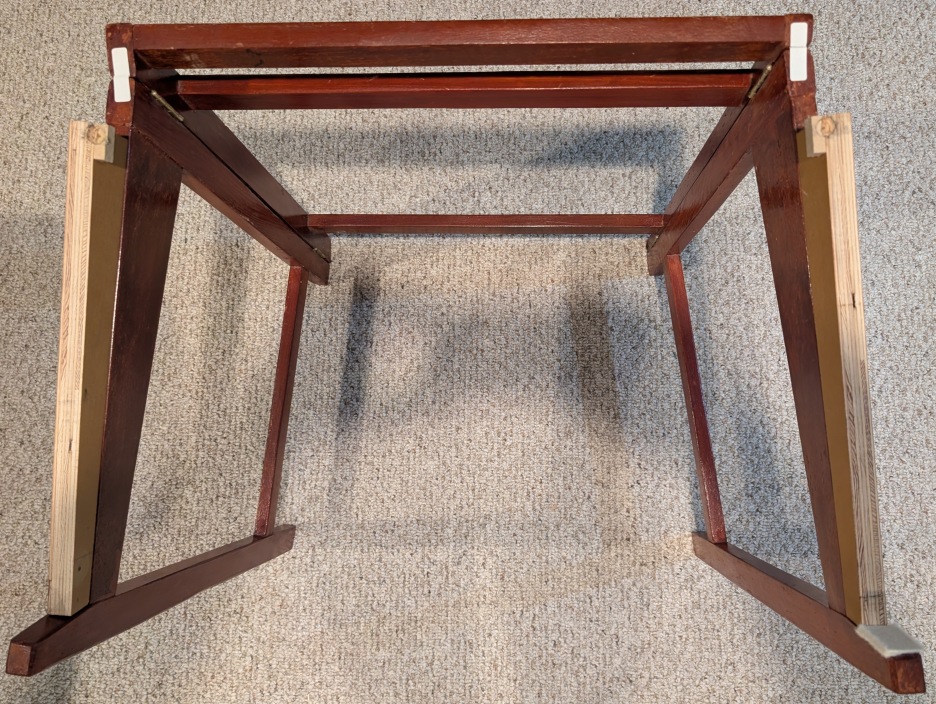
The yangqin stand I have is actually intended for the larger yangqin, which is why its back projects beyond my small yangqin. My shins are too long for this yangqin stand; if I sat straight, the front of the yangqin rested on my knees. So I added two wood wedges to elevate the yangqin and increase its angle. The white strips on the back of the stand are used to align the hinged sides to positions fitting my smaller yangqin. Eventually I will make a smaller stand.
|
| Copyright © 2026 Aubrey Jaffer. | back to Romaniacs |